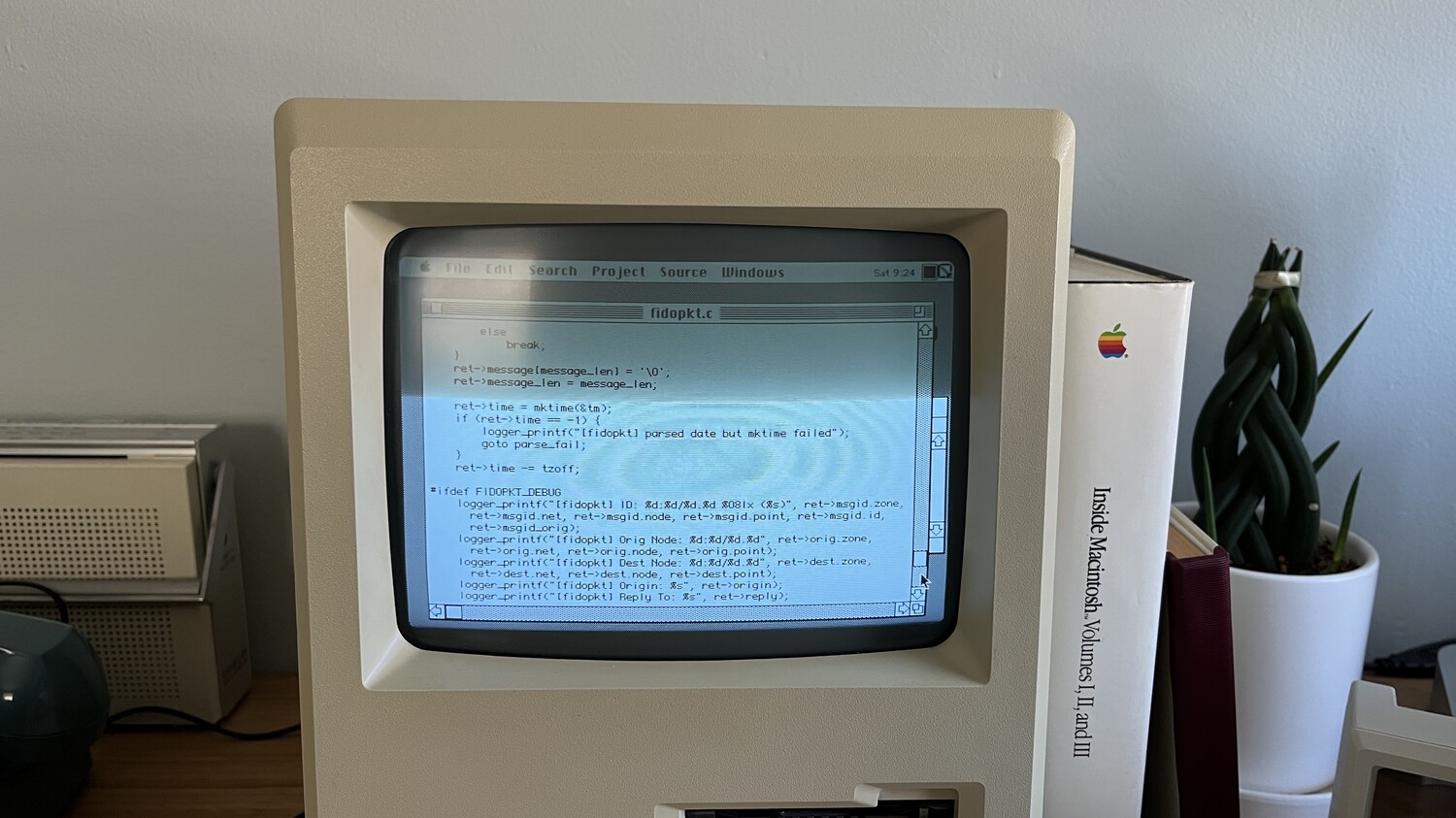
yes but it kinda loss some brightness and get closer to black (specifically the bottom bar)
here with crt filter to show what I see more clearly or https://files.catbox.moe/4pkddi.mp4

yes but it kinda loss some brightness and get closer to black (specifically the bottom bar)
here with crt filter to show what I see more clearly or https://files.catbox.moe/4pkddi.mp4
Another thing most shaders do wrong is curvature, i mean the bezel, sure, it’s curved but the actual image is perfectly flat even on a curved screen. What you seen in front of you on a curved CRT is a perfectly flat image with curved corners.
The image just before your post proves the image is curved as well, or I am missing something (?)
That’s just a camera effect looking at the side, when you sit in front of the curved CRT the image is flat.
true monitor
You need a stable curved bezel png or a separate curved UV corner cut function and leave the actual image UV coordinates flat to be accurate.
my cab, just got the picture.
sometimes you can counteract curvature by using some pots or digital controls, but naturally it is curved.
See how “LEVEL 4” is visible, but “CREDITS 02” or something is eaten by the bezel lol, it it was curved you should still read “CREDITS”
When using those controls the resulting image is not always perfect, you can see the result on my cab as well, or even on the right side of the one you posted before the mac.
In my 80’s TV I clearly remember how distorted were the geometry of panning objects scrolling across the screen.
I giess it depends on the model.
It could be that some 80s TVs have different pincushion settings, not correcting the image. I believe it would introduce moire effects if a TV wasn’t corrected. Way too much “information” squeezed at the corners.
Both exist. It depends on the product’s specifications.
Computer monitors are designed to be viewed from a distance of about half a meter and prioritize accuracy.
Early TVs displayed curved geometry. They were designed to be viewed from several meters away, from various angles, and to transmit analog content. The priority was filling the screen, and overscan was very noticeable. TVs began displaying flat geometry around 90 degrees, perhaps due to the boom in digital content.
There were even slot mask technologies like Super Arch or Invar, which curved the geometry and aligned the content to the edge of the screen to display the image across the entire screen without losing information due to overscan.
Similarly, TVs with curved geometry continued to be released, primarily in the low-end market.
It’s true that the shader draws the scan line perfectly aligned with the “Black Matrix Edge” (the edge of the glass), but that never actually happens.
The flat surfaces aren’t completely flat, and the curved surfaces are slightly less than the screen’s curvature.
Photos need to be in upright position, show all screen, in daylight and not tilted tube to be accurate. If i take a photo focusing on the upper tube/lower tube area it will show curvature anyway even if pincushion correction, as the curved glass plays ball then.
Need to focus in the center of the glass to really understand what goes on, the lens should be at the same height as the tube center which clearly isn’t happening in these photos (it’s much higher exaggerating the curved effect).
I understand that, though I don’t quite get why such a high level of precision is needed to see the curvature.
Some are quite obvious: if the glass is curved and the scan lines follow the Black Matrix Edge, the geometry appears curved. That’s why I included the cropped images. In Image 1, the geometry is straight. In Image 2, the scan lines curve and follow the edge.
If the image is clear, you can count the scan lines; it has a slight tilt to the left.
The three images of the patterns are for reference; while the first one shows flat geometry, the others are Super Arch and Invar, and they are curved. This is more clearly visible in the Super Arch Mask.
You can tell the RCA is not properly corrected, as it introduces moire patterns due to squeezing the image in the corners. Those moire patterns are not visible on the other ones, as they are properly corrected to be almost flat. A camera will not tell the truth 100% on CRTs anyway.