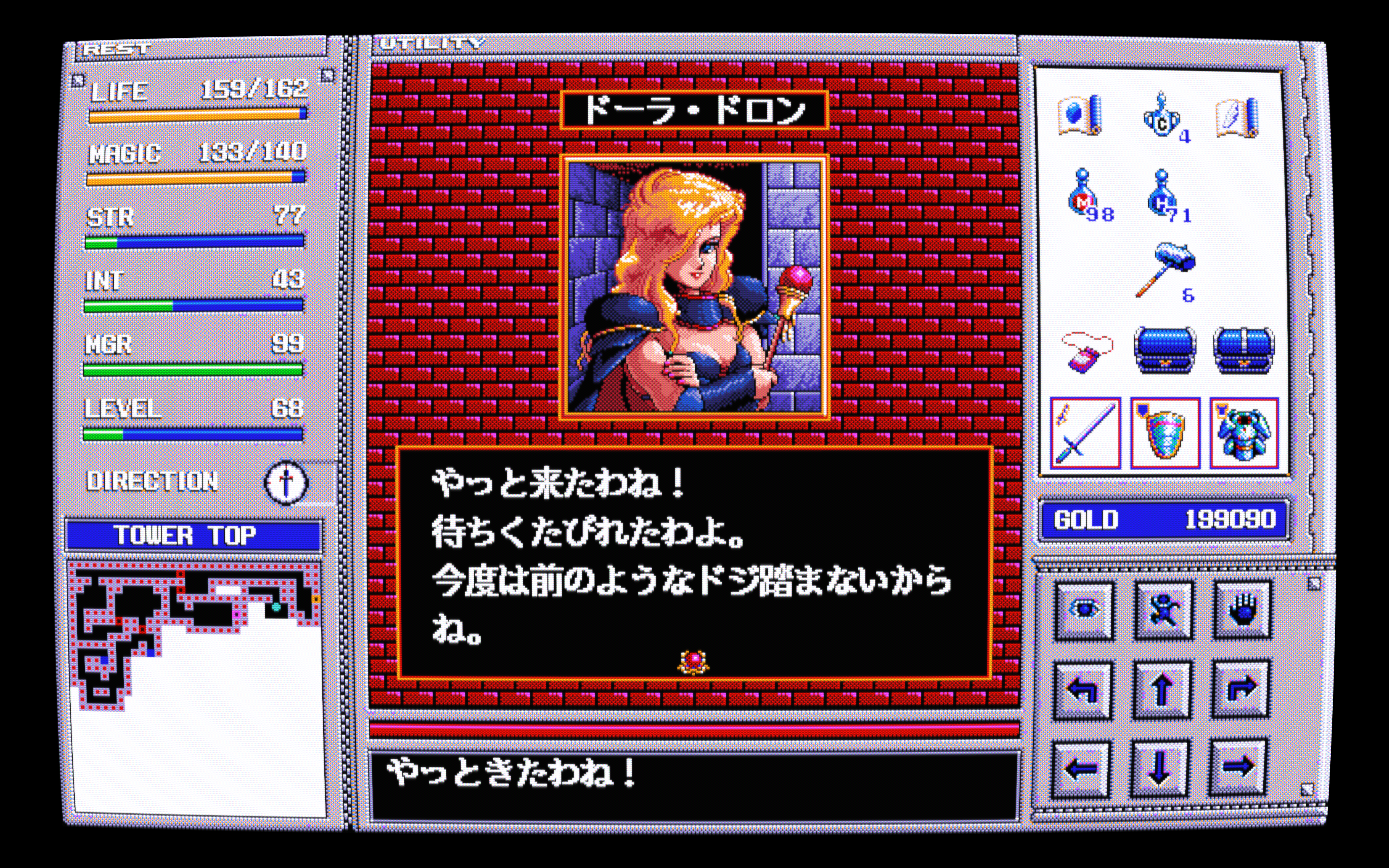
Please show off what crt shaders can do!

Cyber Shadow (running in 4K Display)

Game Config:

  • Window scale x4
  • Integer FullsScreen ON
  • CRT Filter OFF

ShaderGlass Config:

  • Input Pixel Size x2 + Adjust for DPI Scale (200%)
  • Output Scale Free

Shader:

  • Mega Bezel STD (tweaked Soqueroeu)

Shadow of the Ninja Reborn, window mode 1280x720 (running in 4K Display)

ShaderGlass input pixel size 1x, Output scale 200% Shader Guest SlotMask1 (tube effects disable):

Some of these indie games blend highly pixelated sprites with smooth backgrounds and fonts. Because of this, a good mix of elements isn’t always achieved when applying a shader.

Shadow of the Ninja Reborn is an example. In the image below, you can see the character is better defined than the original model, but the elements in the backgrounds appear flattened.

6 Likes

Finally got a 4k OLED! Trying out Katana ZERO again.

No Shader

Newpixie-Clone__SMOOTH-ADV__GDV Shader

6 Likes

Shovel Knight

No Shader

MBZ_0_SMOOTH-ADV-SCREEN-ONLY_GDV

4 Likes

I’ve been trying to find the best way to share HDR screenshots here. JXR files don’t work in Chrome, but AVIF does.

Shovel Knight:

Also, here are the other two screenshots I posted before, but in their original HDR form:

3 Likes

4 Likes

7 Likes

CyberLab Guest Legendary Death To Pixels 4K HDR Shader Preset Pack

5 Likes

Hey there,

Finally got to beat that old Baldur’s Gate 1 and I imported my character in the second game. Started playing on DOSBox Pure with a Win98 VM but wanted to try some mods that wouldn’t be compatible with the old Windows. So here I am with the old collection version installed in Lutris with compatibility mode for Win98. Widescreen mod was working with a custom resolution of 864x486 which was the closest allowed to native 480p and maintaining the sprites big, as I like.

Great game, great atmosphere, awesome mods, and IMO the pixel art really benefits from the reshade port of CRT-Guest-HD, with FSR prepended to upscale 480p to 4K. I run it via gamescope and vkbasalt. You can test and tweak it yourself if you want, here’s the fx file.

https://mega.nz/file/TcwkhQ7Z#SxibM1FAuYN2frFh16hJqCey_ElZ9LnGDNE_R7ho7KY

Here’s a portrait with and without filter for comparison.

raw_jaheira

5 Likes

hi, where can i download these please, looks sick

Steel Ranger (C64, 2018)

6 Likes

That looks fantastic! If it’s not too much trouble; could you provide more information how you got this to work? Since I moved to linux it has been a struggle to get reshade to work at all. I did finally get vkbasalt to launch with reshade shaders like CRT-Guest, but when I try the file you provided here, it does not. I assume this has to do with pre-upscaling your doing with FSR? Though gamescope seems able to resize as well, are you using launch arguments for that?

1 Like

Some more images from CyberLab Guest Legendary Death To Pixels 4K HDR Shader Preset Pack!

Photos of the LCD screen:

Screenshots:

7 Likes

I am finally satisfied with my Ps1 preset. Hope some will find it useful. Here are some screens and the preset itself (just put it in shaders folder, don’t forget to update Retroarch shaders).

https://mega.nz/folder/2fQlwCIB#6O0WrV9NSeP0PyGPSw1JCw!

Enjoy!!

P.S. Just added some new presets if anyone wishes to try.

5 Likes

It is amazing how much more brighter your display can get compared to mine. HDR 600 is not enough I suppose.

1 Like

I’m wondering, how can you tell how bright my display is relative to yours from watching the photos/screenshots. Remember those screenshots need to be either zoomed in or viewed fullscreen in order to get their true brightness.

That depends on how sensitive you are to motion clarity artifacts and how much you’re willing to compromise on the “purity” aka accuracy of your CRT Mask and Scanline Emulation.

Take a look at the following posts, including the embedded ones:

I concur with @Nesguy at least when it comes to monitors:

Guest-Advanced 4k HDR1000 experiments

You can find out some more about the display I use in this post:

1 Like

It is just that games look very dark on my screen compared to photos you uploaded, even after I increase HDR brightness to 1000.

I will certainly check the posts you mentioned.

Thanks

1 Like

Using which presets? In my preset packs there are both presets which look good on dim screens and there are presets which need bright screens.

If you’re talking about your own presets, unless you’re using Sony Megatron Colour Video Monitor there are many settings which you can adjust which can increase the brightness for example Mask Strength, GSL Scanline Type, Bloom, Halation, Glow, Bright Boost, Gamma_C, Contrast.

You can adjust the scanline dynamics so that the beam is thicker and the gaps are thinner. You can use higher TVL mask layouts.

Ultimately, there’s no substitute for raw brightness performance though.

You can increase the HDR Brightness setting but if your screen doesn’t have the nits, it just doesn’t have the nits.

Most Guest-Advanced presets in your HDR pack look like they have very low gamma and brightness, increasing luminance does not solve the problem. I thought they were designed for a display with higher HDR spec, mine does not even allow color adjustments in HDR mode.

1 Like

You don’t have to stick to those but they are easily adjustable using the shader parameters I mentioned.

My previous pack contains PVM/PRO Edition presets for designed for higher brightness output on dimmer displays.

The HDR400 presets I referred to are in my Mega Bezel preset pack but they seem to be broken currently. I fixed most of them but haven’t uploaded yet.

My CRT-Royale preset pack should contain some bright (by my standards) presets.

You’ll also find some bright ones scattered across my Mega Bezel preset pack.

Gamma has been left mostly at default in my latest preset pack. Of course they were designed with my 4K miniLED TV in mind which is much brighter than most monitors, LCD/LED TVs and mid-range OLED TVs.

Hey there,

On windows the fx file attached works with Reshade, as it’s a port of Guest’s shader for Reshade. You can find all the info about how to install it in this topic. When that’s done it’s only a matter of copying the file in the same directory.

First you’d need to upscale de game with FSR to 4k for my file to work out of the box on your install I think. There’s an FSR shader for Reshade in the base shaders that you can load before the CRT shader IIRC. If you dont use 4K resolution you can also tweak the resolution settings ( Resolution_X and Resolution_Y ), and also adjust the mask size (“CRT Mask Zoom (+ Mask Width)”).

The key parameters I usually adjust are

“High Resolution Scanlines (Prepend A Scaler)” set to 1 so the CRT shader doesnt downscale the game

“Internal Resolution”, Tweaked to my tastes for pixel bleeding.

“Internal Resolution Y: 0.5 | Y-Dowsample”, Tweaked to adjust for the numbers of scanlines. Usually 1.5

If you run the game on RA/DOSBox-Pure I shared a preset earlier in this thread for Baldur’s Gate 1. Retroarch is the best to tweak and share presets in my opinion. I got all the original cutscenes recorded here with Guest’s shader, if you’re a bit nostalgic, as they were replaced in the “Enhanced” edition. https://www.youtube.com/watch?v=LM5-Z7VDmDY

If you’re on linux and want to install VKBasalt or see how I got it all running, I also stream Baldur’s Gate 2 on twitch these days, with the same shader. Just completed Shadow of Amn and starting the DLC Throne of Bhaal. Awesome games…

I installed VKBasalt and Goverlay by followin their GitHub readmes, then installed the game with Lutris on Wine staging. In Lutris you can set gamescope for FSR, and for the CRT effect on top, “ENABLE_VKBASALT” = 1 in the environment variables, then edit vkbasalt.conf to load the shader file (either a conf file you create next to the game exe or a global conf file that will apply the shader for all apps).

In vkbasalt.conf

CRT-Guest-HD-480p = /home/USERNAME/.local/share/reshade/Shaders/CRT-Guest-HD-480p.fx effects = CRT-Guest-HD-480p