List of recommended TVs for emulation

2025 miniLED TVs are here! Excellent for CRT Emulation!

https://www.gizmochina.com/2025/03/10/tcl-q10l-qd-mini-led-tv-series-launch-specs-price/

https://www.gizmochina.com/2025/03/09/hisense-launches-e8q-pro-tvs-specs-price/

https://www.tcl.com/us/en/press-releases/tcl-qm7k-launch

This is what’s next:

Is Sony scared of TCL, Samsung and Hisense? They have all announced similar technology on the horizon.

@Nesguy would love this. Now if only they would switch the subpixel layout to RGB from BGR.

Must mention these 2:

https://www.reddit.com/r/RetroArch/s/8dODITqWrq

https://www.reddit.com/r/RetroArch/s/DVDQ2WIdt1

This is probably one of the best TVs you can buy for emulation right now:

  • Precise Dimming Series Up to 5184 Zones
  • · HDR 5800 nits (Peak Brightness)
  • · CrystGlow WHVA Panel (excellent native contrast ratio, black levels and wide viewing angle technology)
  • · 144Hz Native Refresh Rate

Also, based on the reviews of the QM8K which also uses a Crystal Glow WHVA panel, it should have an RGB subpixel layout!

This is the future though:

https://www.youtube.com/live/gMnXc3WfSWs?si=D-mwHjICJ7K0eCX0

I recently learned that the display in the iPad Pro M4 uses tandem OLED but doesn’t have a white subpixel.

According to this the TCL QM851G is brighter than the TCL QM8K making it one of the best TVs for CRT Emulation given its other strengths, however the TCL QM8K is still very bright and it sports better viewing angles and a more CRT-like R-G-B subpixel layout.

What a hard choice.

Hopefully 2026’s offerings or possibly the QM9K will be better than the QM851G in every possible metric. One thing though is that it will always be tough for the newer models to beat the QM851G one price/performance as they’re mostly more expensive.

https://www.youtube.com/live/_14yVGa73k8?si=1r49b2TQyidpJxFC

https://www.gizmochina.com/2025/09/17/tcl-sqd-mini-led-tech-explained/

https://www.gizmochina.com/2025/09/15/tcl-x11l-sqd-mini-led-tvs-launched-specs-price/

2 Likes

Thank you very much for your insightful posts. So, @Cyber and @Nesguy, which TV would you buy today if you wanted the best experience emulating and using shaders? If you could contemplate budget, mid-range and expensive options separately, it would be great.

2 Likes

You’re welcome.

For me it would be a range that I would consider with pros and cons of different options. I think I have already listed what I think might be good options but I’ll try again.

For OLED LG G5, Panasonic Z95B with the caveat that the subpixel layout may not match currently available CRT shader Mask Layouts so some updating and catching up might be required. I think it should be as simple as swapping the subpixel order from the old WOLED layout to the new one but that would probably provide the best overall experience using the very few Mask Layouts that would be supported by those TVs.

LG G4, G3. Those have the advantage of being compatible with current WOLED Mask Layout options while being bright as well.

OLED TVs do suffer from burn-in and ABL does kick in and dim your screen during gaming, especially if you like leaving the TV in the options menu while listening to video game music.

miniLED TVs - Extremely Bright miniLED TVs also provide the best experience but in different ways to OLED and in ways that OLED TVs probably can’t match yet. They’re generally much more flexible in terms of the Mask Layouts and CRT TVLs that they can competently emulate and their brightness is second to none, which is very important for CRT emulation, especially when motion clarity enhancing techniques are used. The downsides are mainly in the poorer viewing angles and blooming which can be noticed in less than ideal viewing conditions, for example off axis viewing and in dark environments.

TCL QM9K, TCL QM8K - Among the brightest TVs ever made, Wide viewing angle technology and R-G-B subpixel layout.

TCL QM851G - One of the brightest TVs ever made. Better specifications and performance than the very good TCL QM751G. I would have a hard time choosing the TCL QM8K over this because it is brighter than the QM8K. That additional brightness headroom can be useful when trying to improve motion clarity by the use of BFI or the CRT-Beam Simulator. I like that the QM8K has the R-G-B layout though, that’s cool.

Sony Bravia 9, TCL QM751G, TCL QM7K, Sony Bravia 7 - The Sony Bravia 9 is among the most accurate TVs in existence and I have the TCL QM751G so I know it can pass the test. The QM7K is actually slightly dimmer though and it also has less (albeit higher precision) dimming zones.

The Sony Bravia 7 should be a decent alternative to the TCL QM751G/QM7K but it has less dimming zones and I don’t think it’s brighter than either of them either.

4 Likes

It depends on how realistic you want to get with shaders. For fully accurate mask emulation, you want 100% mask strength, which can reduce brightness by more than 90% in some cases. This means you need brightness, lots of brightness.

The DisplayHDR 1000 spec is what you should be looking for. This is pretty much exclusive to MiniLED. (It’s on a few FALD LCDs but you want MiniLED- it’s basically the same thing with more dimming zones and the current tech)

If you can afford it - DisplayHDR 1000 True Black. This is only possible with the latest OLED tech and currently only found on a few high-end small screen devices (laptops, tablets).

https://displayhdr.org/certified-products/#tab-1000

I’m currently running a KTC M27P20P.

It doesn’t have the greatest build quality, and quality control on this brand is abysmal, but it has the DisplayHDR 1000 spec, and it’s affordable.

DSE is very bad on these. I had to play the panel lottery several times - out of 8 displays they sent me, only 2 were acceptable in terms of backlight uniformity. So be prepared for that. I bought this last year, so there are likely better options, now.

Shaders on this monitor absolutely blow away anything else I’ve ever seen, and I’ve been doing this stuff for about 15 years.

Black level with local dimming off is a bummer, I’ll admit. But HDR1000 True Black will be affordable soon, give it 5 years.

3 Likes

Once again, thank you very much, @Cyber and @Nesguy! I think all the bases are covered with your posts. I’ll let you know once I buy something, and I will post pictures here too, in order to help others to decide.

3 Likes

Here are some renditions from my TCL QM751.

1 Like

Damn, I should have waited! lol.

@yepes you may want to check this one out. This is the one I wish I had waited for.

4 Likes

Sorry for late reply. I’ll check it out!

For my future setup, I’ll probably use a TV, since it will be used by my family too, but since I’m in need of a second monitor for my PC I may end up getting your recommendation!

2 Likes

Greetings @Nesguy, the first post of this thread is getting a bit long in the tooth. Don’t you think an update is long overdue?

Hope all is well.

Question:

Will any OLED be just fine for CRT Emulation?

Answer:

Definitely not. OLED displays generally don’t have the standard vertical R-G-B/B-G-R striped subpixel layout that subpixel aware CRT Shaders rely on in order to map modern display subpixels to emulated CRT Phosphors.

So only a handful of low TVL Masks can be acceptably emulated and only on WOLED. Due to QD-OLED’s triangular subpixel structure, the CRT-Subpxel Mask emulation is always off/inaccurate.

Only recently OLED panel makers have started to address this.

In addition to that, accurate emulation of Masks/Phosphors and Scanlines demands that most of the pixels of the display are turned off/darkened which makes things very dark. Add BFI/Beam Simulator/Pulsar aka Backlight Strobing and it gets even darker.

The solution? Shaders which compromise accuracy for the sake of brightness or very bright screens.

MiniLED screens far outshine OLED displays in this department. Even a Mid-Range miniLED can be brighter or just as bright as the brightest OLED displays, especially in sustained brightness.

Luckily OLED panels can squeeze some more brightness out of lit pixels the more unlit pixels are off so that can offset the brightness deficit relative to miniLED a bit.

miniLED can’t do that per pixel energy conservation so must rely instead on having much higher brute force sustained brightness potential. Due to their standard subpixel structure, many more mask layouts can be properly emulated and represented via the LCD subpixel structure which is not too dissimilar from an Aperture Grille CRT’s Phosphor structure.

Lastly, while modern OLED displays might be better at handling burn-in, there is always the risk of those emulated scanlines and scanline gaps wearing out unevenly.

1 Like

Related to this, if one were to buy an OLED TV in 2026 for emulation (due to the wider viewing angles and deeper blacks), which model would you recommend?

I know miniLED TVs perform better in most cases, but viewing angles still lag behind OLED TVs, so some people might prefer the latter.

Thanks in advance!

1 Like

The brightest you can get that doesn’t compromise on gaming or other features/strengths that would also benefit emulation and then secondary uses.

So any WOLED with an MLA panel, LG G3, G4. You can go tandem OLED but as stated before, it’s untested and unproven if current CRT shader subpixel mask layouts would be compatible.

So there might be a little lag before they’re actually fully supported as help would be needed from users and / developer who actually have access to the TVs to fully test the subpixel layout.

Nobody talks about this but it took years before RWBG/WOLED TVs had decent CRT shader support and advocacy to develop, test and implement them in shaders was mostly a done by a tiny handful of vocal folks who had those TVs in the community.

So LG G4, G3 would be easy recommendations although I don’t recommend OLED TVs for this.

LG G6, LG G5, Panasonic Z95B with the caveat about the new subpixel layout and uncertainty about Panasonic’s tonemapping, gaming features and the OS.

I really like the OLED image for emulation, even if it’s not very accurate.

I used to be afraid of burn-in, but a recent test by R-tings showed that LCDs in general suffer much more from it.

I’m starting to get burn-in on my LCD monitor myself, after only 2 years of use…

Interesting statement. While I also like the OLED image for emulation, have you ever experienced good CRT Shader Presets on a good miniLED display with >=720 local dimming zones, Peak 10% Window 1,466 cd/m², Sustained 50% Window 860 cd/m² with BFI before in order to actually compare how it might fare?

Also, not all OLED displays are incapable of accurate subpixel CRT emulation. RWBG/WOLED displays are very capable of accurate CRT emulation, however they are limited in the subpixel mask petterns that they can accurately simulate vs a display with a standard R-G-B/B-G-R vertical subpixel stripe.

No, before buying an OLED I had a regular LED, I even considered a miniLED, but I found the OLED image more pleasing.

https://youtu.be/ekBsy-G4czg?si=m7o1eKeeH3fcwNIX

https://www.reddit.com/r/TCL_Official_UK/s/WXnFmsj1zV

1 Like

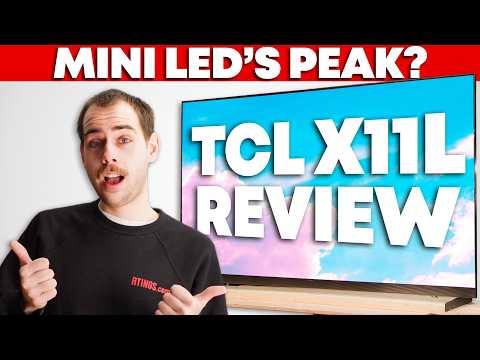
TCL X11L

11,000+ Nits Peak Brightness, RGB Subpixel Layout, the closest LCD has come to OLED according to RTINGS and many other review outlets.

Here are some excerpts from RTINGS’ review of the set.

Note: Due to the high peak brightness of the TV, we had to use different measuring equipment for many of our tests, as the TV exceeds the peak luminance of our Colorimetry Research CR-100, which we normally use. As such, we combined our CR-100 with a Colorimetry Research CR-250 when necessary, as it’s designed for higher luminance measurements, but it’s not as sensitive as the CR-100 in low-light conditions.

11,000+ Nits Peak Brightness anyone?

HDR Brightness In Game Mode

Peak 2% Window    11,020 cd/m²
Peak 10% Window    4,547 cd/m²
Peak 25% Window    3,002 cd/m²
Peak 50% Window    1,571 cd/m²
Peak 100% Window    805 cd/m²
Sustained 2% Window    774 cd/m²
Sustained 10% Window    397 cd/m²
Sustained 25% Window    791 cd/m²
Sustained 50% Window    562 cd/m²
Sustained 100% Window    804 cd/m²

Content mastered in the BT.2020 color space is where the improved quantum dots on this TV really shines, and it has better coverage of the BT.2020 color space than any other LED TV tested up until now.

It displays dark, saturated colors well, and bright highlights aren’t washed out by whites at all.

Panel Technology

Panel Type: LCD

Sub-Type: VA

Subpixel Layout: RGB

The TCL X11L uses a combination of new panel technologies, including an improved color filter, a new WHVA 2.0 panel structure, and improved quantum dots, which TCL calls Super Quantum Dots.

The spectral power distribution shows the impact of the SQD layer. Compared to the TCL QM8K, we can see that there’s no change at all to the blue backlight, but the green peak has shifted 10 nm towards blue. The biggest change is with the reds, which are far more powerful and more precise, and the center wavelength has increased by 20 nm. This results in a far greater separation between green and red, resulting in more precise, saturated reds.

HDMI 4 (4x HDMI 2.1)

HDMI 2.1 Rated Speed 48 Gbps

ATSC Tuner 3.0 (NEXTGEN TV)

USB Ports3

USB 3.0 Yes (1)

Audio Out 3.5mm 0

Wi-FiYes (2.4 GHz, 5 GHz)

Ethernet Speed 100 Mbps

Composite In 0

Digital Optical Audio Out 1

The TCL X11L is the first TCL TV on the market to feature four full-bandwidth HDMI 2.1 ports. There’s also an additional USB port on the side bezel of the TV.

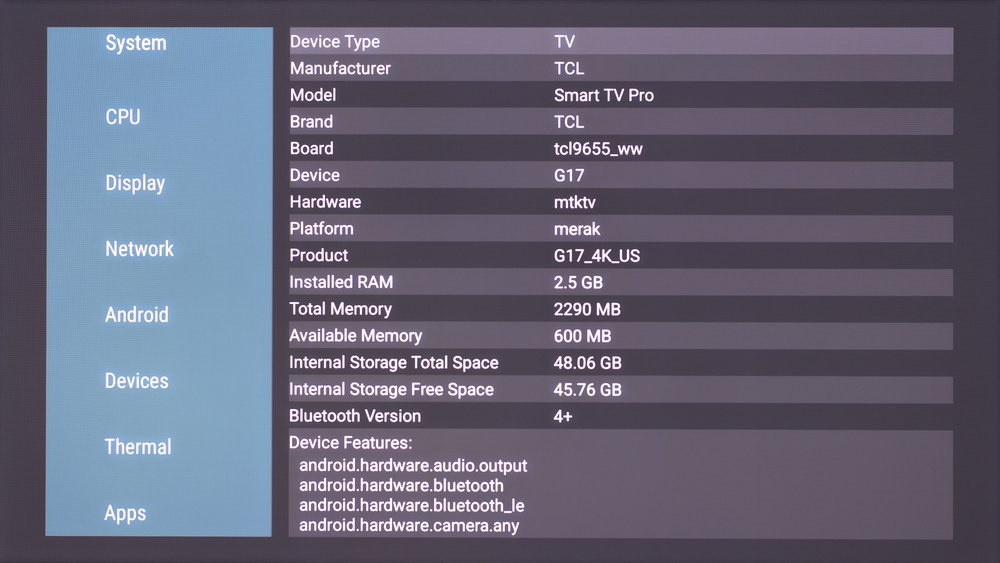
Running the AIDA64 app on the TV confirms that it’s powered by the new MediaTek Pentonic 800 chipset, with 2.5GB of RAM and 48GB of internal memory.

What do you think about TCL’s claim of “up to 100% BT.2020 coverage, with a possible deviation of ≤5%,” in relation to your measured results?

Exact copy and paste from their website: *100% BT.2020 refers to a typical value of the area ratio under the BT.2020 color gamut standard. The test data comes from TCL laboratories. Due to differences in test environments/test standards/test equipment, as well as other reasonable and objective factors such as different products/production batches, a deviation of ≤5% may occur.

That’s most likely referring to flat color gamut coverage, whereas our test looks at gamut rings instead. They’re not comparable. It’s not just different methodology or equipment; it’s a completely different test.

1 Like

While it sounds great on paper, I’ve read some concerns about this TV regarding input lag and motion blur. Do you think these two aspects could affect this TV’s potential as an emulation TV?

I don’t rush to believe everything I read or see in a review. I take stuff like that along with anecdotal accounts with a huge helping of salt. Sometimes it’s user error, laziness, a user just not understanding a new or different design choice from they were accustomed to, a firmware bug e.t.c.

So I try to look beyond stuff like that and see if there’s a fundamental issue with the hardware and technology itself that would be the underlying cause of such.

I’ve seen people say all sorts of things about certain TCL models, while other users have not had the same experiences.

Some TVs or systems in general may perform to one’s liking out of the box while others may need some adjustments.

I’m saying this also from the perspective of someone who has used high end and mid-range TVs from multiple manufacturers who now owns and uses a TCL QM751G as my daily driver.

Based on most of the reviews I looked at on YouTube, there doesn’t seem to be any cause for concern in that regard. There was one very vocal reviewer who had negative things to say about that one area you mentioned but what is the context of those statements?

Different people are sensitive to different things, firmware is still relatively early as well. I’ve had an extremely positive experience with the updates I’ve received on my QM751G over the last year and a half.

In closing, there was nothing in the RTINGS review which was any cause for concern especially when it came to motion and gaming performance.

“On paper” measurements are very important metrics as they help to rule out conclusions based on potentially subjective, biased and flawed testing.

Another thing about that TV and my reason for including it here is the mere fact that we have reached to this point in our history where we have more than enough brigtness headroom for accurate CRT emulation, in a TV with an R-G-B subpixel layout and probably the largest colour gamut, contrast and blooming performance of any LCD display before it!

Look at the price of that thing though. It’s hardly a mainstream offering. So I look forward to seeing what the QM8L and QM7L can bring to this space.

I also await more reviews and updates regarding RGB miniLED technology. One camp is saying that there are issues with colour crosstalk but Sony just revealed their offering and that phenomenon was nowhere in sight and those who witnessed it had nothing bad to say about that. If Sony can figure it out maybe other manufacturers can as well.

I’m sure you’re aware that TCL recently acquired Sony’s TV and consumer electronics business. So let’s see what that brings to the table in the not too distant future.

One thing I wanted to add, it’s TCL, a company known for making great budget TVs which gamers have enjoyed for over a decade which have excellent input lag. The TV uses the new MediaTek Pentonic 800 SOC which is a more powerful processing chip than the ones in its predecessors. We’ve seen WHVA 2.0 in action before in the QM8K and QM9K.

It’s input selection is finally on par with LG’s boating 4 full bandwidth 48Gbps HDMI 2.1 ports.

What would have to happen under the hood for it to have issues with input lag and motion blur?

The only thing that comes to mind besides immature firmware is probably heat. Maybe the internals get so hot that it can affect the SOC performance under certain conditions? Who knows? It’s still early days though and the vast majority of reviews didn’t seem to have any of those issues.


1 Like